Berliner Zeitung has published an in-depth interview with PJA founding members Aurélia Kalisky and Nahed Samour, on the occasion of our upcoming first annual conference in Berlin.
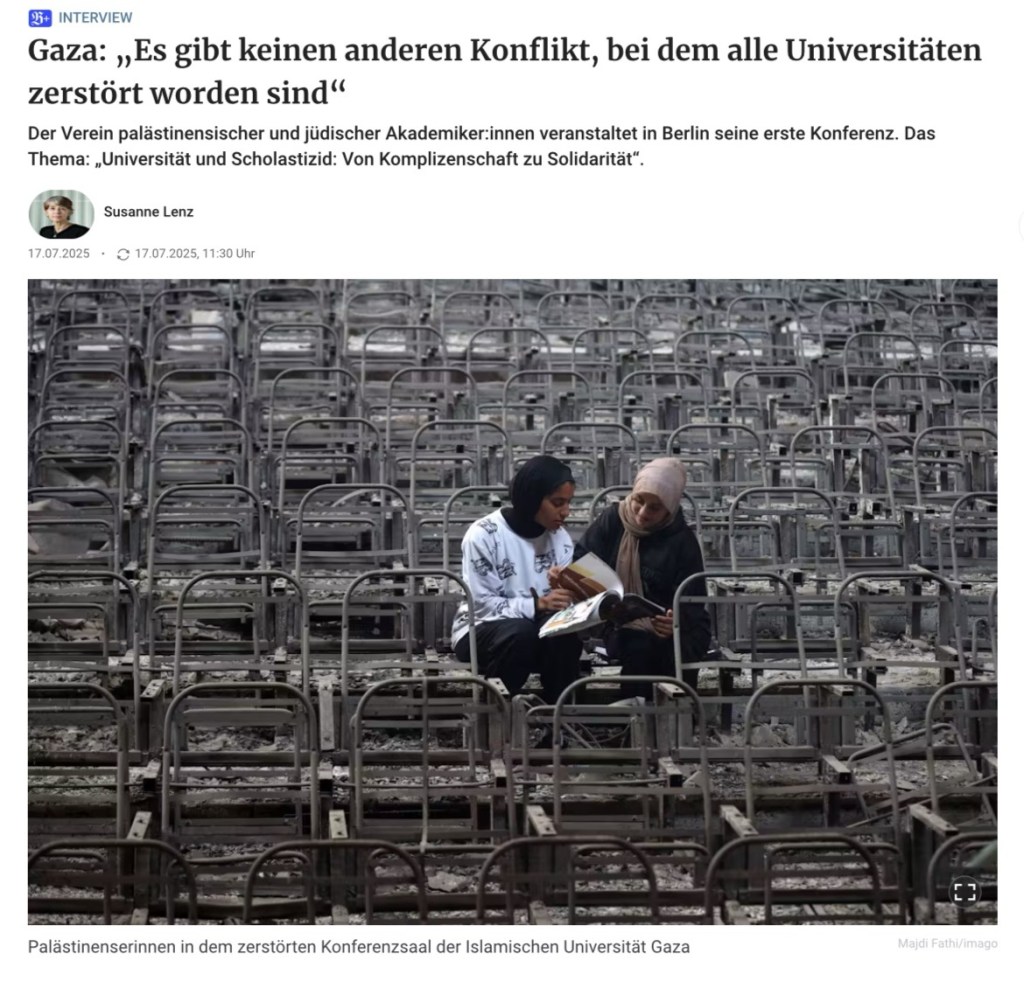
The article, Gaza: ‘There is no other conflict in which all universities have been destroyed’, addresses the unprecedented destruction of all eleven universities in Gaza during Israel’s current military campaign—a level of devastation that has “not occurred in any other conflict” says Samour. This form of targeted academic destruction is discussed under the concept of “scholasticide”: the systematic elimination of educational institutions, knowledge production, and cultural memory.
In the interview, Kalisky and Samour speak about the founding of PJA in response to increasing repression of Palestinian and critical Jewish voices in Germany. They describe the association as a space of joint resistance to the framing of Palestinians and Jews as enemies and to the silencing of dissent within German academic and public discourse.
The article also draws attention to the daily realities of academic life under siege. From the complete destruction of Gaza’s largest institutions—including the Islamic University and Al-Azhar University—to the loss of archives, libraries, and scientific research, the consequences are far-reaching. The term “scholasticide” is offered not just as a descriptor, but as a political framework for understanding the scale and intent of this destruction. “In light of the targeted killing of university presidents, faculty, and students, it would be difficult to use any other term” says Kalisky.
Kalisky and Samour argue that European academic institutions, especially in Germany, must confront their complicity and take a stand—not only against the genocide, but against the silencing of knowledge and critique.
📖 Read the full article (in German, paywall): https://www.berliner-zeitung.de/kultur-vergnuegen/debatte/gaza-es-gibt-keinen-anderen-konflikt-bei-dem-alle-universitaeten-zerstoert-worden-sind-li.2340425
Following is an English translation of the interview:
Gaza: “There is no other conflict in which all universities have been destroyed”
The Association of Palestinian and Jewish Academics is hosting its first conference in Berlin. The theme: “University and Scholasticide: From Complicity to Solidarity.”
By Susanne Lenz | July 17, 2025
The Association of Palestinian and Jewish Academics is hosting its first annual conference this Sunday in Berlin, titled “University and Scholasticide: From Complicity to Solidarity.” We spoke with founding members Aurélia Kalisky and Nahed Samour about the conditions of higher education in Gaza and the West Bank, and about academic discourse in Germany.
How did your association come about?
Aurélia Kalisky: We are a non-profit association in formation, with around 50 members from a wide range of disciplines. Since October 7, 2023, we’ve observed the growing polarization and hardening of the debate in Germany. Our goal is to push back against the accompanying repressive developments in discourse and policy around Palestine/Israel. We wanted to show solidarity as academics and speak together — especially because, here in Europe, and particularly in Germany, Palestinians and Jews are so often portrayed as adversaries. We all either come from Germany and/or work here and are familiar with German academic institutions. We are a German-speaking association.
You’re holding your first conference this weekend in Berlin, on the topic of scholasticide. Who coined that term?
Nahed Samour: The term was coined in 2009 by Palestinian scholar Karma Nabulsi. Even then, there were Israeli practices and laws that made it difficult for Palestinian academics to build and maintain educational systems under conditions of violent occupation. In addition to the destruction of Palestinian educational institutions, archives, and libraries — long before October 7 — this also includes restricted mobility. Education requires the mobility of students and scholars. And it has become increasingly difficult for international scholars to teach at Palestinian universities. That’s how knowledge is dried up.
The term scholasticide has gained renewed relevance now that all eleven universities in Gaza have been destroyed — including archives, libraries, and laboratories. And we have to acknowledge, unfortunately, that this has hardly prompted any critical response from academics in Germany — nor from German universities as institutions.
Aurélia Kalisky: The term is also connected to culturicide, coined by Edward Said. Scholasticide is a key element of colonial and genocidal violence. It goes hand in hand with the erasure of collective memory and the destruction of the means to narrate and pass on one’s own history through education and research. That’s why scholasticide and culturicide are also linked to concepts like mnemocid and futurocide (Stéphanie Latte-Abdallah).
The term sounds difficult — like a superlative of horror — even though the destruction of cultural institutions in Gaza is dramatic.
Kalisky: Given the targeted killing of university presidents, faculty, and students, it’s hard to use any other word. The Israeli army even destroyed the last remaining walls of institutions like the Islamic University of Gaza — with the aim of erasing all traces of Gaza’s rich academic past.
But Hamas is waging a guerrilla war — using civilian structures like hospitals, schools, and universities for cover.
Samour: We’ve heard that argument many times, without any internationally verified evidence. It sounds like a convenient excuse. There is no other conflict in which all universities have been destroyed.
A photo caption notes: Students celebrated their graduation at the University College of Applied Sciences in Gaza City in 2023. The university has since been completely destroyed by Israeli airstrikes, and its president was killed in the bombing.
Is there any access to education at all in Gaza right now?
Kalisky: There is international solidarity — very concrete, through online teaching and other alternative methods that also support Palestinian scholars.
Samour: On Monday, three university presidents from Gaza published an open letter emphasizing that higher education continues. It’s also a call to the international academic community to provide technical and logistical support — and to seek new partnerships. That’s what our conference is trying to highlight: the possibilities for such collaboration. These conversations are already happening in Europe — at universities in Jena, Florence, Ghent, and Uppsala. The question is: what role do universities want to play in the world, and in their own cities?
In the face of Russia’s illegal war of aggression against Ukraine, universities played a central role. That’s the kind of engagement we want to build on.
Are there already partnerships between Palestinian and German universities?
Samour: Before October 7, there were some memoranda of understanding — but very few had actual funding. In general, German universities haven’t answered the question of whether they want to support research from and in Palestine. Instead, budgets for cooperation with Israeli universities have been increased.
Kalisky: Scholasticide began long before October 7 — with the 17-year blockade of Gaza, which made it impossible for universities there to conduct normal research. No materials could enter. Publishing opportunities were severely limited. In the West, there was virtually no solidarity with Gaza’s universities.
Even apart from the blockade, it’s worth remembering that the Israeli state did not authorize a single higher education institution in Gaza before 1978.
A second photo caption notes: Israeli troops in armored vehicles storm the courtyard of Birzeit University in Ramallah, central West Bank.
What has the situation been like for higher education in the West Bank?
Samour: West Bank universities are also heavily restricted — by settler violence, countless military checkpoints, limited mobility, arrests of faculty and students, and frequent raids by Israeli forces. International scholars need a residency permit from Israel — but if you want to teach at a Palestinian university, you won’t get one. That’s been the case since 2019. All international faculty had to leave the West Bank that year.
Your conference also focuses on the role of students. Why is that important?
Samour: Some of the most urgent questions today are being raised by students. Researchers often avoid confronting the role of universities. We’ve deliberately invited colleagues from European universities so we can join an ongoing discussion — rather than provincializing ourselves.
Kalisky: As a Holocaust scholar and a researcher in Jewish studies, I reject the idea that the German Bundestag should tell me how to define antisemitism. I’m referring here to the IHRA definition, which has been widely criticized internationally. It restricts how I can talk about the situation in Israel and Palestine.
This shows how Germany’s highly politicized and ideological approach to anything related to the Israel/Palestine discourse is affecting the credibility of academic research. The scholasticide — the destruction of all knowledge produced by Palestinian scholars on Palestine and Israel — is echoed here in Germany through an intellectual impoverishment of academic life. Research freedom is curtailed, and cooperation continues with Israeli institutions where international law violations should instead prompt critical reassessment.
***
 Association of Palestinian and Jewish Academics